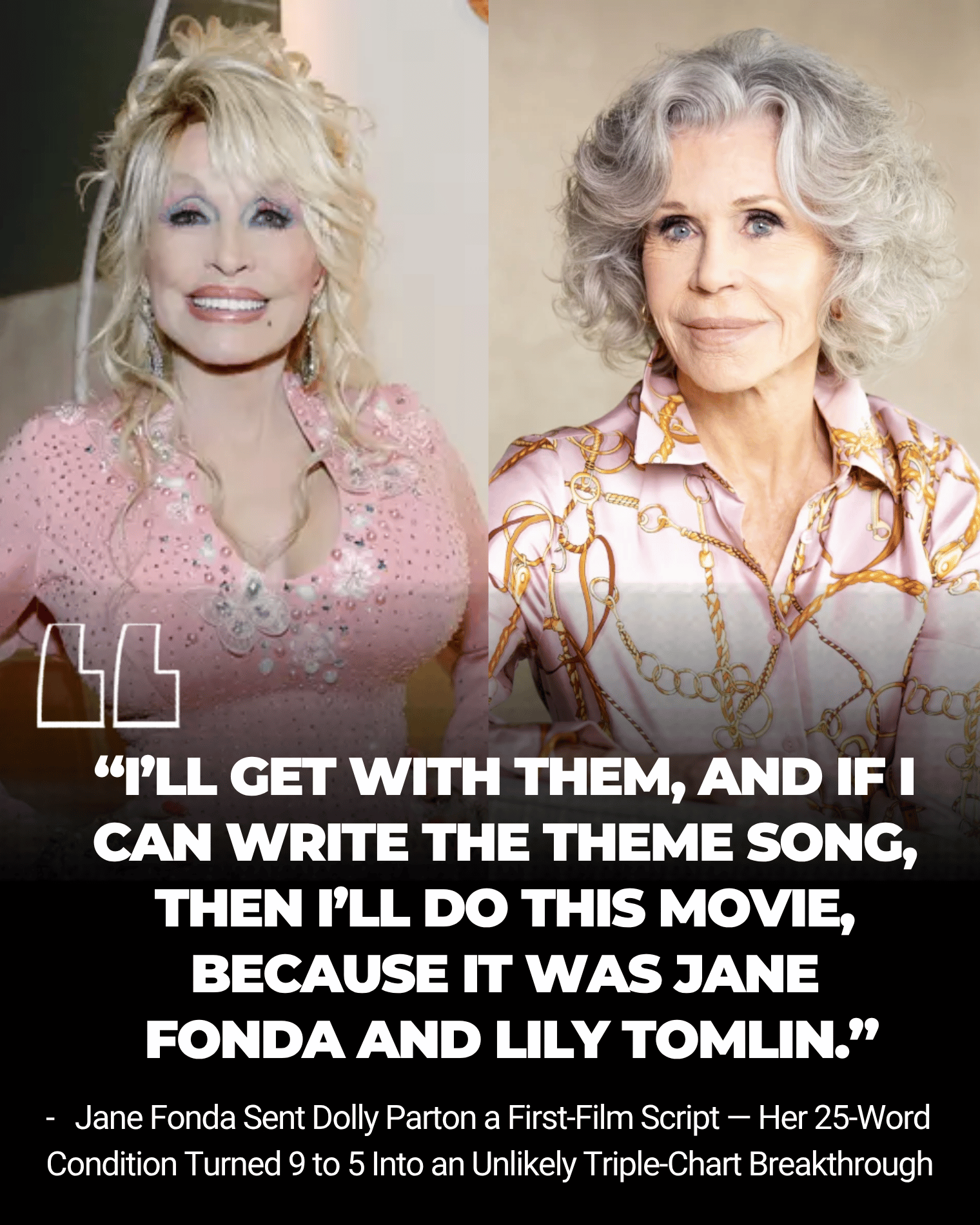
Dolly Parton was already a music giant when Jane Fonda came calling, but movies were another game entirely. Parton had turned down earlier film offers, refusing to step into Hollywood just because fame made the door swing open.
Then Fonda sent her the script for 9 to 5, with Lily Tomlin already part of the plan. The pitch was not just another starring vehicle; it was a sharp workplace comedy with three women ready to carry the whole fight.
Still, Dolly did not simply say yes and smile for the cameras. She came with a condition that sounded bold, practical, and completely Dolly: “I’ll get with them, and if I can write the theme song, then I’ll do this movie, because it was Jane Fonda and Lily Tomlin.”
That 25-word answer turned a casting decision into a creative power move. Parton was not entering the film as a guest from another world; she wanted to bring her songwriter’s instincts with her.
The wild part is that the condition did not just protect her comfort. It helped create one of the most recognizable songs of her entire career.
During filming, Parton noticed the rhythm of office life and found music in the smallest possible gesture. She clicked her acrylic nails together, mimicking the sound of a typewriter, and the pulse of 9 to 5 began taking shape.
That image is pure Dolly: glamorous nails, workplace frustration, and a hit song hiding in plain sight. While the film skewered bad bosses and everyday exhaustion, Parton turned the office machine into percussion.
The song did not feel like a pasted-on theme written after the fact. It sounded like it had climbed directly out of the movie’s world, carrying the tension, humor, and grind of the story.
For a first-time actress, Parton did more than survive the leap into film. She helped define the entire project’s sound, turning her condition into the heartbeat of the movie.
Then the numbers made the story even crazier. 9 to 5 reached No. 1 on country, pop, and adult-contemporary charts, proving the theme could cross audiences as easily as Dolly crossed into acting.
Jane Fonda may have sent the script, but Dolly arrived with a demand that changed everything. She did not just join Fonda and Tomlin onscreen; she made sure her voice framed the whole rebellion.
The result was not a polite Hollywood debut. It was a triple-chart breakthrough, a career expansion, and a reminder that Dolly Parton never entered a room empty-handed.
She came with conditions, acrylic nails, and a melody sharp enough to turn office drudgery into pop history.