
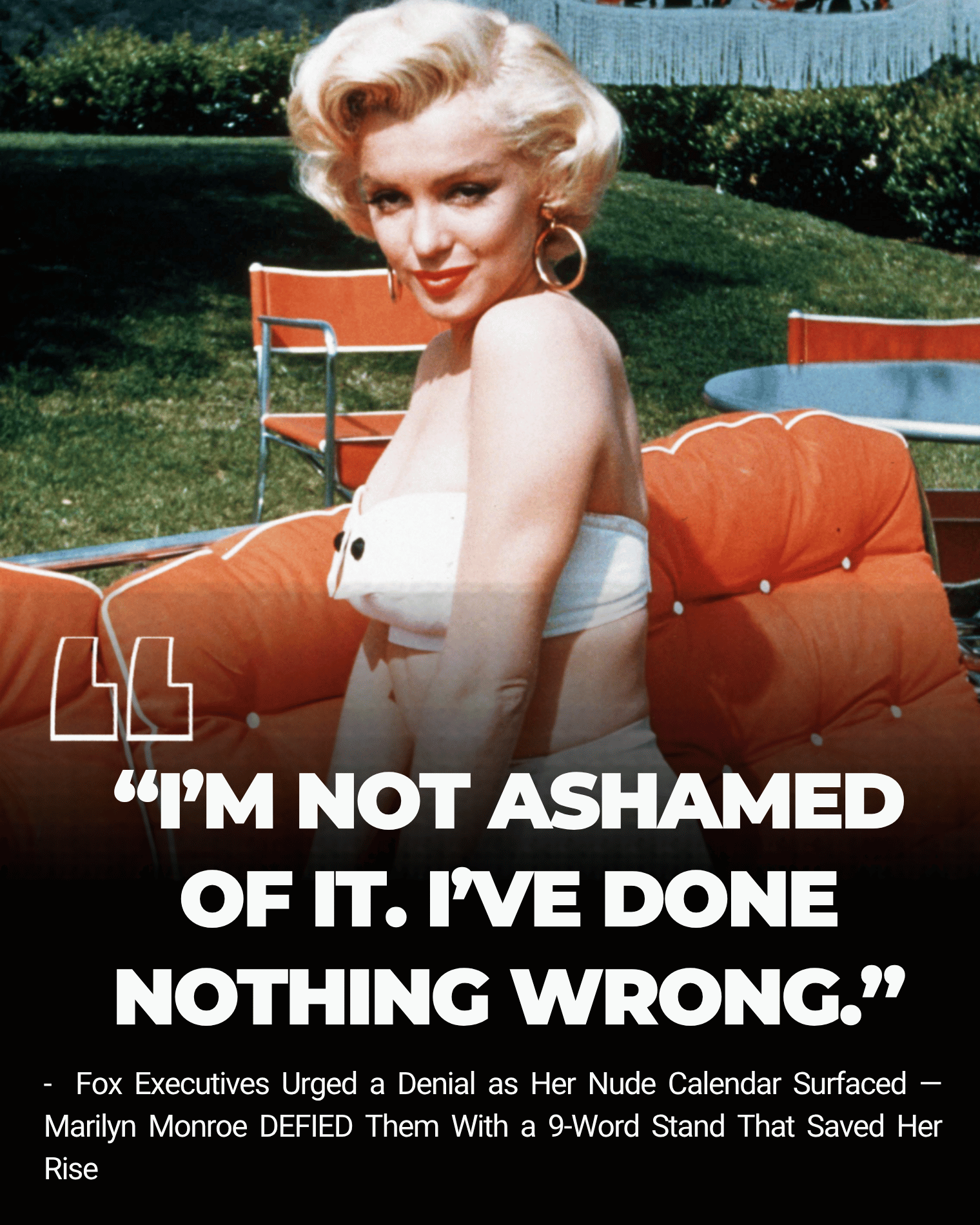
“I’m not ashamed of it. I’ve done nothing wrong,” Marilyn Monroe declared, delivering nine words that turned a studio emergency into one of Hollywood’s most unforgettable displays of self-possession.
In 1952, the rising star was still fighting for every inch of her future, while Twentieth Century-Fox watched each headline as nervously as it watched the box office.
Then a calendar featuring Golden Dreams, a 1949 photograph from before fame had completely found her, threatened to explode across newspapers and derail the ascent.
Fox executives reportedly saw panic, fearing the image would stain a performer they were preparing to promote through Clash by Night and the coming spectacle of Gentlemen Prefer Blondes.
Their instinct was the old Hollywood instinct: deny, deflect, bury the truth, and hope the public would look away before it could damage the carefully assembled blonde bombshell fantasy.
But Monroe refused to wear shame that did not belong to her, choosing candor over concealment even when the people protecting the studio’s investment wanted silence.
Working with columnist Aline Mosby, Monroe moved before the gossip machine could turn her personal history into a weapon designed to humiliate her.
She acknowledged the photograph without excuses, explaining that she had needed money at the time, then calmly refused the idea that survival required an apology.
That decision was breathtakingly risky in an era when studios controlled images ruthlessly and women were often punished simply for refusing to perform innocence on demand.
Instead of collapsing her career, the revelation flipped the entire script, exposing a young woman who was neither helpless nor willing to let men rewrite her life.
The public did not see a manufactured scandal; many saw honesty, vulnerability, and a determination that made the actress seem startlingly human beneath the spotlight.
What Fox feared would destroy Monroe’s momentum only sharpened the force of her appeal, making her feel less like a studio invention and more like a woman fighting through one.
The timing could not have been more dramatic, because Clash by Night was ready to show a tougher Monroe while Gentlemen Prefer Blondes would soon supercharge her superstardom.
Her calendar confession did not erase Hollywood’s cruel gaze, but it denied the system its favorite weapon: forcing a woman to apologize for existing outside its script.
By standing still in the center of the storm, Monroe made the panic look small and made her own voice impossible to ignore.
Years later, the episode still lands like a warning shot from a star who understood that public image could be both a cage and a stage.
Marilyn Monroe did not claim perfection, and she did not ask anyone to rescue her; she simply insisted that she had done nothing wrong.
In nine defiant words, she turned a supposed career-ending scandal into proof that the most powerful version of her fame was always the one she controlled.