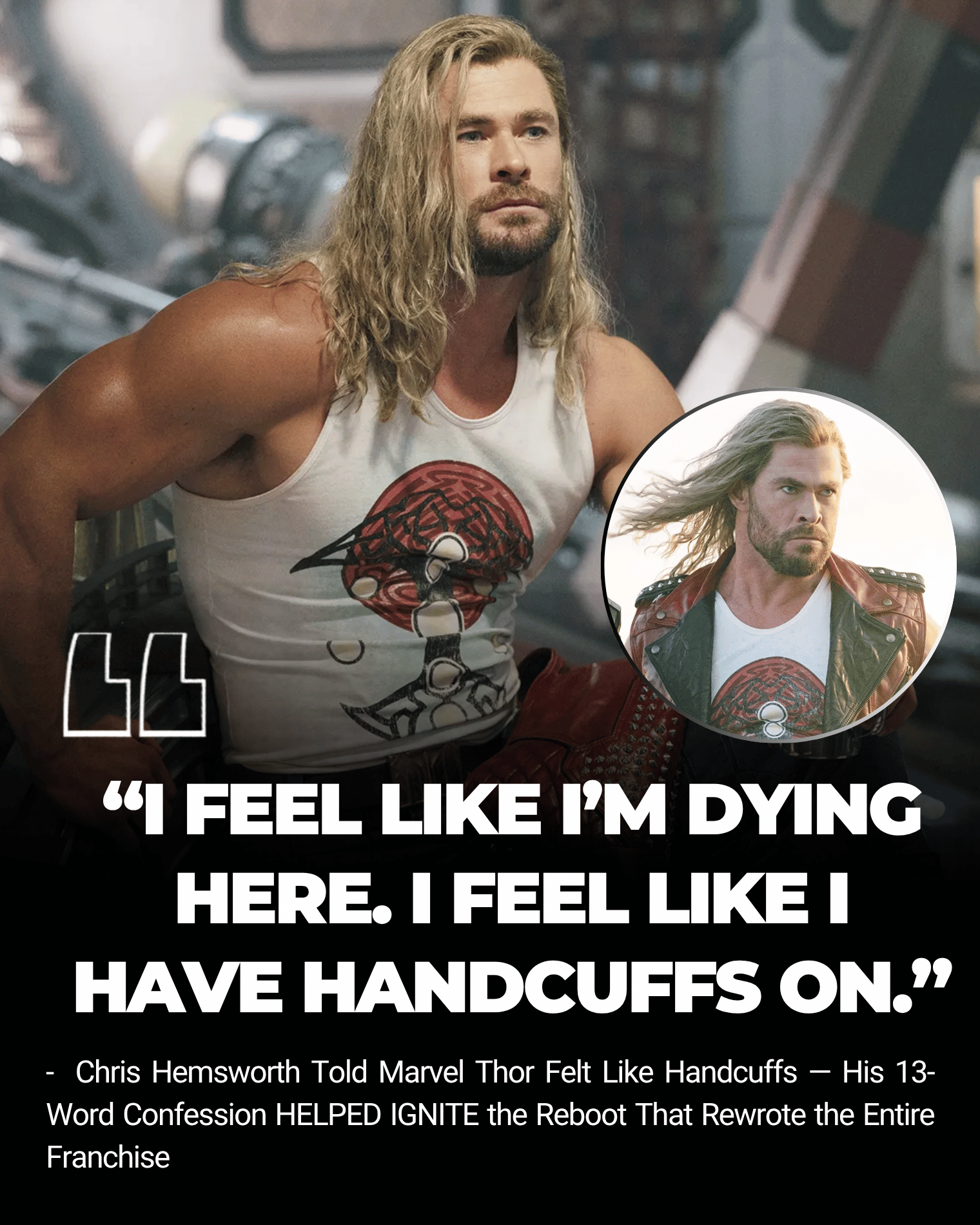
Chris Hemsworth was already a global superhero fixture, but behind Thor’s thunderous hammer, the actor reportedly felt the character was slipping into a stiff, familiar routine.
After Thor: The Dark World and Avengers: Age of Ultron, Hemsworth sensed the God of Thunder was trapped inside solemn speeches, polished poses, and an increasingly predictable heroic formula.
The pressure finally boiled over before Thor: Ragnarok, when Hemsworth took his frustration directly to Marvel Studios president Kevin Feige instead of quietly accepting another round of thundercloud seriousness.
His message was not subtle, dramatic, or carefully packaged for a franchise meeting. Hemsworth reportedly told Feige, “I feel like I’m dying here. I feel like I have handcuffs on.”
That blunt confession became the warning bell Marvel apparently needed, because Hemsworth was not asking to abandon Thor; he was begging to discover a version worth playing again.
The actor wanted the character to loosen up, surprise audiences, make mistakes, and stop behaving like every dramatic pause had been carved into ancient Asgardian stone.
Feige listened, and the studio’s answer came with Taika Waititi, whose wild creative energy would eventually send Thor crashing into a stranger, brighter, and much funnier universe.
Waititi did not simply adjust the tone around Hemsworth; he blew open the entire character’s carefully guarded image, replacing noble stiffness with comic timing, vulnerability, chaos, and genuine unpredictability.
Suddenly, Thor could be ridiculous without becoming weak, emotional without becoming melodramatic, and funny without losing the larger stakes that kept Marvel’s universe humming.
Thor: Ragnarok arrived in 2017 looking like a full-scale jailbreak from the franchise’s old expectations, with neon spectacle, bizarre humor, and a hero who finally seemed thrilled to be alive.
Hemsworth’s Thor was no longer just delivering grand pronouncements beneath stormy skies; he was getting thrown around, arguing with friends, losing control, and laughing in the middle of disaster.
That tonal gamble transformed what could have been another routine sequel into a Marvel reset, giving audiences a hero who felt newly human beneath all the godlike armor.
The change also reignited Hemsworth’s own connection to the role, proving that even the biggest blockbuster characters can lose their spark when repetition starts sounding louder than imagination.
For Marvel, the moment became bigger than one actor’s dissatisfaction, because Hemsworth’s honesty helped reveal a franchise problem before it hardened into a permanent creative trap.
And for Thor, the so-called handcuffs did not end with a quiet complaint in an executive office; they snapped open into Ragnarok, turning a restrained superhero into one of Marvel’s most volatile stars.