Aretha Franklin did not walk into her reign on a red carpet.
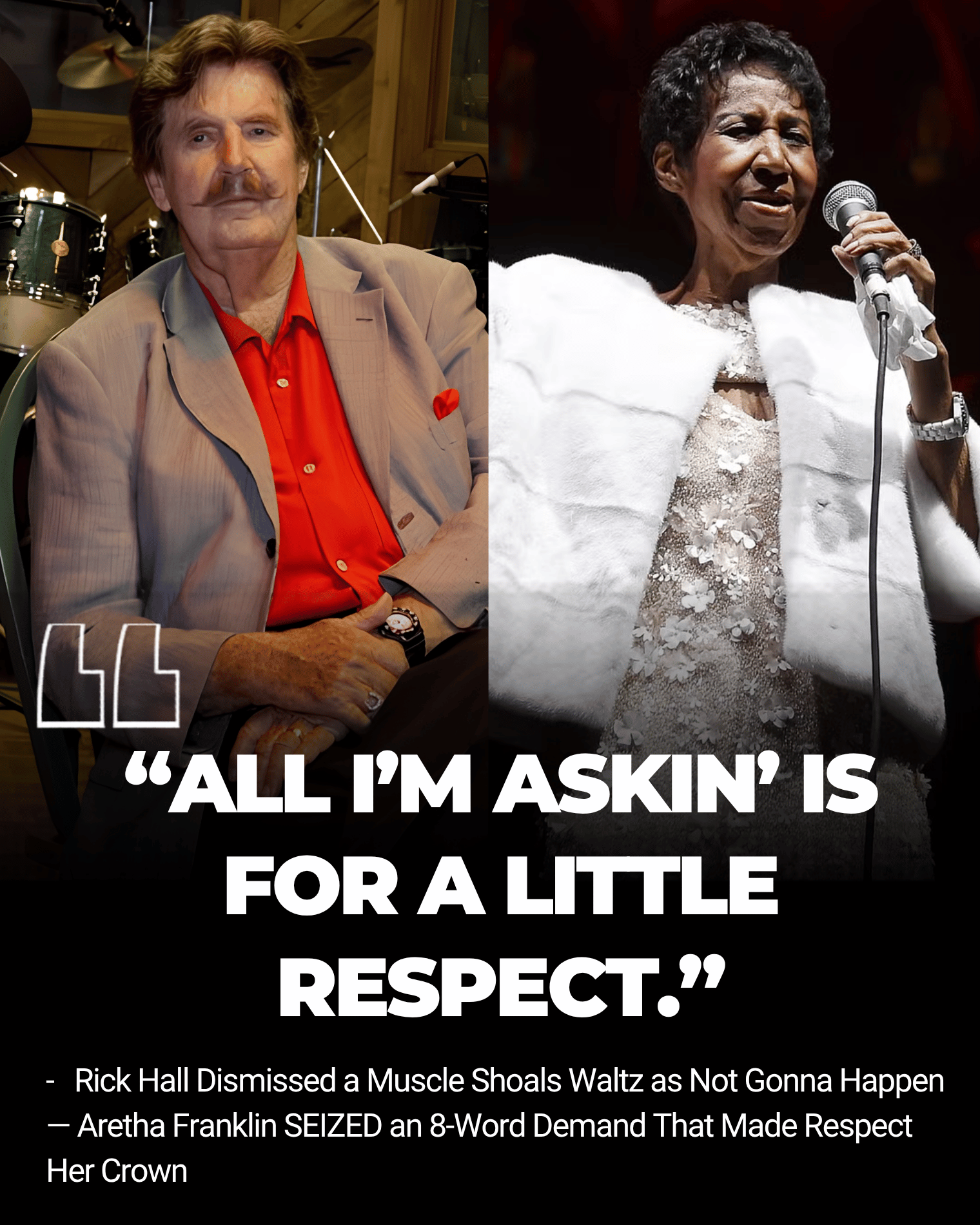
Before “Respect” became a crown, her first major Atlantic chapter nearly cracked open inside the heat and tension of a Muscle Shoals session.
The studio was supposed to be the place where a new Aretha finally broke free from years of confusion at Columbia.
Instead, the session around “I Never Loved a Man” spiraled into a fight involving Ted White, Ken Laxton, and Rick Hall.
That kind of blowup could have killed the momentum completely.
A new label, a fragile new start, and suddenly the room was filled with conflict instead of the clean birth of a superstar era.
Rick Hall later treated the unfinished direction like something that might not survive the mess.
But Aretha’s voice had already found a lane nobody could easily close.
The power around “I Never Loved a Man” refused to disappear in the fallout.
Even after the tension, even after the break in the session, the sound was there, raw and undeniable.
Then came “Respect,” the song that changed everything.
Aretha took Otis Redding’s original and did not simply cover it; she seized it, rewired it, and made it answer to her.
At the center was the demand that became immortal: “All I’m askin’ is for a little respect.”
Eight words, and suddenly the song was no longer just a plea inside a relationship.
It became a command.
It became a woman’s declaration, a Black artist’s battle cry, and a cultural line so sharp that listeners could feel the floor shift beneath it.
That was Aretha’s genius.
She could take a borrowed man’s song and make it sound like it had been waiting for her voice all along.
Where Redding’s version had its own swagger, Aretha’s version carried authority.
She did not sound like someone asking permission; she sounded like someone collecting what was already owed.
The spelling, the phrasing, the bite, and the gospel-rooted force turned the record into something bigger than pop.
It was catchy enough for radio and deep enough to become part of a movement.
The twist made the victory even sweeter.
Columbia had spent years trying to figure out what to do with Aretha, polishing and positioning her without fully unleashing the storm inside her voice.
Atlantic did not have to invent that storm.
It only had to stop getting in the way long enough for the world to hear it.
“Respect” hit No. 1, and the old doubts suddenly looked tiny.
The fight in Muscle Shoals, the fractured session, and the early uncertainty all became background noise to the arrival of the Queen.
For women, the song landed like recognition.
For civil-rights listeners, it carried the weight of dignity demanded in public, not whispered behind closed doors.
By the end, Aretha Franklin had done more than survive a chaotic start.
She turned an unfinished breakthrough into a throne, and made eight words of respect sound like a nation being told to listen.